

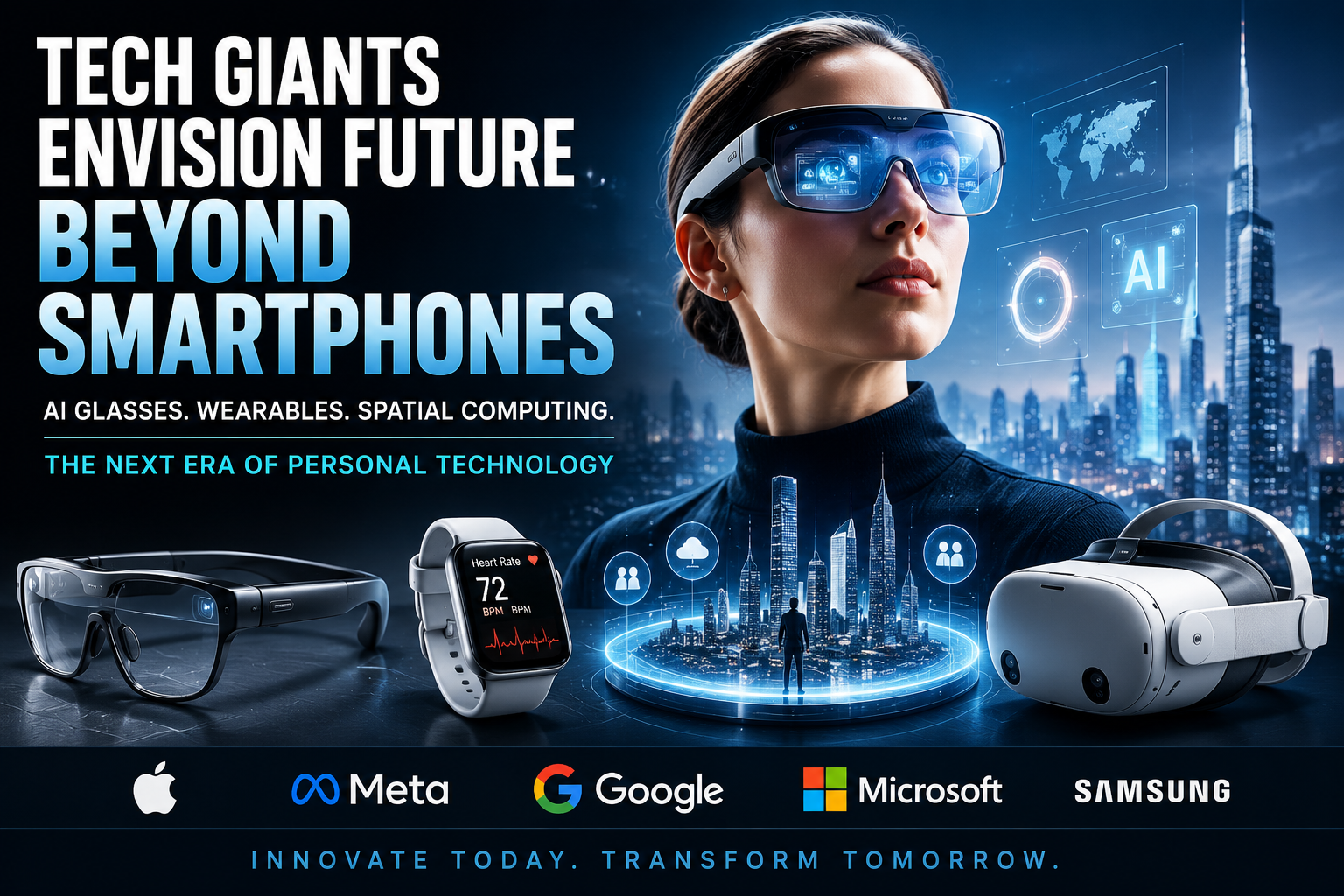
The smartphone has dominated our lives for nearly two decades, but a seismic shift is underway. As artificial intelligence evolves from a tool we summon on a screen to a constant, context-aware companion, the device in your pocket is losing its monopoly on your attention. Tech giants envision a future beyond smartphones—one defined by distributed, ambient computing where AI agents live in your glasses, on your wrist, in your car, and in the data centers powering them all. This isn’t science fiction; it’s the strategic direction of the world’s most valuable companies, and it’s happening right now.
Why Tech Giants Envision Future Beyond Smartphones Now
The numbers tell a compelling story. Global smartphone shipments are projected to decline by more than 12% in 2026, falling to around 1.09 billion units. This isn’t merely a cyclical downturn; it signals the end of an era defined by breakneck growth. For nearly two decades, the smartphone market experienced relentless expansion, but that trajectory has flattened. Consumers are holding onto their devices longer, upgrades offer diminishing returns, and innovation has become incremental rather than revolutionary.
For companies like Qualcomm, the “kingmaker” of the smartphone age, this presents an existential challenge. The company built its fortune on the chips that connect phones to cellular networks, but its core market has plateaued. “This round of smartphone inventory adjustment is nearing its end,” Qualcomm CEO Cristiano Amon acknowledged. Even as the cycle improves, he noted that “incremental space in the smartphone industry has long since dried up.” This realization has forced the entire tech ecosystem to look beyond the screen for their next growth engines.
The financial stakes are enormous. The smartphone industry has generated trillions in revenue over the past decade, but the law of large numbers dictates that growth cannot continue indefinitely. Major players are now redirecting their R&D budgets toward emerging categories like augmented reality, wearable AI, and ambient computing. This strategic pivot represents the most significant transformation in consumer technology since the introduction of the iPhone itself. As tech giants envision future beyond smartphones, they are placing billion-dollar bets on entirely new computing paradigms.
Qualcomm’s Billion-Dollar Bet on AI Infrastructure
The solution for many tech giants is a radical transformation of their business models. At its 2026 Investor Day, Qualcomm unveiled its most aggressive diversification strategy in company history. The chipmaker now aims to generate $400 billion in non-handset revenue by fiscal 2029, more than doubling its previous target. The message was unmistakable: the age of mobile-first is giving way to an AI-first future, and the battleground has moved decisively beyond the smartphone. When tech giants envision future beyond smartphones, they see data centers as the new frontier.
The data center represents the most lucrative front in this new war. The immense computing power required to train and run large AI models has sparked an infrastructure gold rush. Qualcomm, once a peripheral player in enterprise computing, is now targeting a staggering $150 billion in data center revenue by 2029. This ambition puts it on a direct collision course with Nvidia, the undisputed king of AI chips, which currently dominates the market with its graphics processing units.
To compete effectively, Qualcomm is building an entire ecosystem from scratch. Its plan revolves around the newly unveiled “Dragonfly” brand for data center chips, starting with the C1000 CPU, based on its NUVIA acquisition, with samples expected by late 2026. Crucially, Meta has already signed on to use the Dragonfly C1000 for its next-generation servers, while Microsoft has committed to using Qualcomm’s new AI chips for its Azure cloud platform. These major partnerships validate Qualcomm’s technical approach and provide a significant competitive advantage.
This is more than just a hardware play. To challenge Nvidia’s all-powerful CUDA software ecosystem, Qualcomm is acquiring AI-software startup Modular for $3.9 billion. Modular’s technology allows AI models to be run efficiently across different types of chips, providing a potential “open” alternative to Nvidia’s walled garden. This dual hardware-software strategy mirrors the approach that made Qualcomm dominant in mobile and positions it as a formidable contender in the AI infrastructure market. As tech giants envision future beyond smartphones, they recognize that the infrastructure layer will be just as valuable as consumer devices.
Meta’s Vision: Smart Glasses and the War on the iPhone
While data centers power the AI revolution from afar, the battle for the consumer’s primary interface is even more personal. Tech leaders are openly dreaming of the post-smartphone era, and their visions are starting to take tangible shape. Meta CEO Mark Zuckerberg has been the most vocal, declaring a “war on the iPhone” and betting heavily on AI-powered smart glasses as the eventual successor to the smartphone. Zuckerberg clearly believes tech giants envision future beyond smartphones, and he wants Meta to lead the charge.
Zuckerberg’s “Personal Superintelligence” vision aims to create a device that sees and hears what we do, acting as a constant digital companion. He believes glasses are the ideal form factor because they can be worn all day, providing a frictionless interface for an AI that anticipates our needs. “As soon as you add a display… it unlocks a huge amount of value,” he has stated, describing a future where the AI generates interfaces for you on the fly rather than requiring you to navigate through apps. This represents a fundamental rethinking of human-computer interaction.
Meta’s strategy is already showing results. The company’s Ray-Ban smart glasses, which look and feel like a normal accessory, have exceeded sales expectations and proven that consumers are willing to adopt AI-enhanced wearables when the design is appealing. These glasses allow users to capture photos, listen to music, and interact with Meta’s AI assistant through natural voice commands. The success suggests that the path to mainstream adoption lies not in inventing entirely new product categories but in embedding powerful AI into familiar, desirable form factors.
Qualcomm’s Amon shares this view, suggesting that 2026 is “the year of the agent” and that personal AI devices will soon become ubiquitous. He points to glasses as the most obvious form factor, arguing they are natural and allow the AI to see what you see. But he also envisions a world of “jewelry, badges, and pendants” that connect us to our intelligent agents, creating an ecosystem of ambient computing where the smartphone is just one component among many. This is exactly what happens when tech giants envision future beyond smartphones—they create entirely new categories of personal technology.
OpenAI’s Bold Hardware Gambit
OpenAI, the company at the forefront of the generative AI boom, is perhaps the most intriguing new entrant in the hardware race. Its widely publicized collaboration with legendary designer Jony Ive is finally taking shape, and its route to the market is unconventional, signaling a deliberate departure from established paradigms. OpenAI firmly believes tech giants envision future beyond smartphones, and they’re building products to prove it.
While many expected a direct competitor to the smartphone, OpenAI’s first hardware is reportedly a mobile, screenless smart speaker with a camera and moving parts, designed to feel “alive” and interactive. This device, potentially arriving in early 2027, is designed primarily for home use. It represents a clear strategy to create an AI-first device that isn’t burdened by the legacy of apps and touchscreens that define the smartphone experience. By doing so, OpenAI can pioneer a new interaction paradigm where the AI itself is the primary interface.
This is just the first step in a broader hardware roadmap. Reports indicate OpenAI is also developing an “AI Agent phone” for production in 2027, alongside a product roadmap that includes smart glasses and earbuds. The company’s goal is to establish a network of AI-powered devices that are not controlled by Apple or Google’s app store ecosystems, thereby securing an independent hardware foothold for its models. This vertical integration strategy—building the model, the operating system, and the hardware—mirrors Apple’s approach and could position OpenAI as a formidable consumer electronics player.
The financial and strategic implications are significant. By owning the hardware, OpenAI can capture more of the value chain and ensure its models are the primary AI interface on millions of devices. It also provides a hedge against potential platform restrictions from Apple and Google, giving the company more autonomy and negotiating leverage. For consumers, OpenAI’s entry could accelerate innovation and provide a compelling alternative to the dominant mobile platforms. This is precisely what happens when tech giants envision future beyond smartphones—new players emerge to challenge the established order.
AI Hardware Learns from Past Failures
Not every attempt to escape the smartphone’s shadow has succeeded. The failure of products like the Humane AI Pin, a wearable projector that was plagued by overheating, poor battery life, and limited functionality, serves as a stark reminder of the engineering and market challenges that await new entrants. As one industry observer noted, a device that has never been seen before must constantly answer “what it is, what it’s for, and why you wouldn’t just use a phone instead.”
This has driven a new, more pragmatic approach to AI hardware. Instead of inventing new “species” of devices, companies are embedding AI into familiar forms that consumers already understand and love. The success of Meta’s Ray-Ban smart glasses proves that AI can be a powerful add-on to an existing, beloved product. Similarly, AI is being integrated into headphones, earbuds, and even niche products like the “Tianpule AI Guitar,” which embeds a music-generation model into the instrument itself. As tech giants envision future beyond smartphones, they’re learning that evolution often beats revolution.
The lessons from early failures have reshaped the industry’s approach. First, battery life and thermal management remain critical engineering challenges that cannot be compromised. Second, user experience must be intuitive and additive, not confusing or redundant. Third, new devices must offer clear, compelling value that justifies changing behavior and wearing technology in new ways. Companies that learn from these failures are better positioned to succeed, while those that repeat the same mistakes will inevitably struggle.
The Future Is Ambient Computing
Despite the buzz and the billions being invested, the smartphone is not about to disappear. Its ecosystem is too vast, its utility too ingrained, and its network effects too powerful. Even Zuckerberg admits that his goal is to “reduce the time people spend staring at their phones,” not to make them disappear entirely. Apple CEO Tim Cook has similarly argued that new devices are more likely to be complementary to the iPhone than outright replacements, suggesting a more gradual evolution. Even as tech giants envision future beyond smartphones, they acknowledge the smartphone’s enduring relevance.
Instead of a sudden death, we are likely to see a gradual migration of workloads. As Amon points out, when personal computers arrived, we didn’t stop using pen and paper. When smartphones arrived, we didn’t stop using PCs. Some tasks shifted, and some devices simply became more specialized. This pattern is repeating. The smartphone will remain the central hub for many high-intensity tasks—gaming, deep work, complex communication—but the ambient, low-friction computing tasks will increasingly be handled by wearables.
The innovation will be in how these devices work together. This concept of ambient computing, where intelligence is distributed across multiple devices that collaborate seamlessly, represents the true future. Your smart glasses might handle quick information queries, your smartwatch might monitor health metrics and provide notifications, your car might manage navigation and entertainment, and your phone might serve as the processing hub for more demanding tasks. The key is that the system works together intelligently, with context-aware AI making decisions about which device is best suited for which task. This is the reality tech giants envision future beyond smartphones.
The tech giants are positioning themselves for this new reality. The race is no longer just about building the best phone; it’s about building the AI that will live on all of them. Companies like Qualcomm are betting on the infrastructure layer, while Meta and OpenAI are focused on consumer devices and interfaces. Microsoft and Google are investing across the stack, from cloud infrastructure to consumer applications. The competition is fierce, and the winners will shape how billions of people interact with technology for decades to come.
What This Means for Consumers
For the average consumer, this transition brings both exciting possibilities and practical considerations. The most immediate impact will be the proliferation of AI-powered features on existing devices. Even before new hardware categories achieve mainstream adoption, your smartphone will become significantly smarter, with AI assistants that understand context, anticipate needs, and automate routine tasks. This represents a substantial improvement in user experience, making technology more intuitive and less demanding of your attention. This is the first step as tech giants envision future beyond smartphones.
As new devices like smart glasses and AI wearables become available, consumers will need to make choices about which devices to adopt and how to integrate them into their daily lives. The key will be identifying use cases where wearables offer clear advantages over smartphones. For example, smart glasses that provide navigation without requiring you to look at a phone screen, or AI earbuds that translate conversations in real time, offer compelling value that could drive adoption.
Privacy and security considerations will also become more complex as AI becomes more pervasive. Devices that see what you see and hear what you hear raise legitimate concerns about data collection and surveillance. Consumers will need to be thoughtful about which devices they trust with sensitive information and demand transparency and control from manufacturers. Companies that prioritize privacy and provide clear user controls will likely gain a competitive advantage as tech giants envision future beyond smartphones.
The economics of personal technology are also shifting. While smartphones have become relatively affordable, early AI wearables are likely to be expensive. As the market matures and competition increases, prices should come down, making these devices accessible to a broader range of consumers. The total cost of ownership may also change, with subscription-based models for premium AI services becoming more common.
Market Trends Shaping the Transition
Several market trends are accelerating the transition beyond smartphones. The explosive growth of generative AI has demonstrated the potential for machines to understand and generate human-like content, opening new possibilities for human-computer interaction. Investment in AI startups reached record levels in 2025 and 2026, with billions flowing into companies developing novel interfaces, models, and applications. This investment climate is precisely what enables tech giants to envision future beyond smartphones.
The maturation of augmented reality technology has also been crucial. AR headsets and smart glasses have improved dramatically in recent years, with better displays, longer battery life, and more comfortable form factors. While still early, these devices are now capable enough for practical applications like navigation, translation, and information overlay. As the technology continues to improve, the barrier to adoption will continue to fall.
The rise of 5G and edge computing has created the network infrastructure necessary for ambient computing. Low-latency connectivity allows AI processing to be distributed between devices and the cloud, enabling real-time responses and reducing the computational burden on wearables. This makes it practical to build lightweight, battery-efficient devices that rely on cloud intelligence for complex tasks.
The regulatory environment is also evolving. Governments around the world are developing frameworks for AI governance, data privacy, and emerging technologies. These regulations will shape how companies develop and deploy new devices, potentially accelerating or slowing the transition depending on the specific requirements. Companies that proactively address regulatory concerns and build trust with consumers will be better positioned for long-term success as tech giants envision future beyond smartphones.
Expert Insights on the Future of Computing
Industry leaders offer diverse perspectives on what the future holds, but there are common themes. Cristiano Amon of Qualcomm emphasizes the importance of distributed intelligence, where AI processing occurs at the device level to ensure privacy and responsiveness, while more complex tasks are handled in the cloud. This hybrid approach balances capabilities with practicality and is likely to define the architecture of ambient computing. This is exactly how tech giants envision future beyond smartphones—through distributed, intelligent systems.
Mark Zuckerberg’s vision emphasizes personalization and integration, with AI agents that understand individual users and adapt to their needs over time. He sees these agents becoming trusted digital companions that help manage daily life, from scheduling and communication to entertainment and information. This user-centric approach resonates with consumers who are increasingly seeking technology that simplifies rather than complicates their lives.
OpenAI’s approach, driven by Sam Altman, emphasizes the importance of creating entirely new interaction paradigms rather than improving existing ones. The company’s investment in screenless, voice-first interfaces reflects a belief that the future of computing is conversational and ambient rather than app-based and screen-focused. This philosophical difference sets OpenAI apart from incumbents and positions it as a potential disruptor in the hardware space.
The consensus among experts is that the transition will be gradual but ultimately transformative. “We’re in the early innings of a multi-decade shift,” notes a leading industry analyst. “The smartphone won’t disappear, but its role will evolve. Five years from now, we’ll look back and realize how much has changed.” This perspective underscores why tech giants envision future beyond smartphones—it’s not about overnight change but long-term transformation.
Key Takeaways
- The smartphone market is plateauing, with global shipments projected to decline over 12% in 2026, forcing major tech companies to find new growth drivers and diversify their revenue streams. This is why tech giants envision future beyond smartphones.
- Data centers are the new battleground for AI dominance. Qualcomm is pivoting aggressively to challenge Nvidia, aiming for $150 billion in data center AI revenue by 2029 with new chips, strategic acquisitions, and partnerships with Meta and Microsoft.
- The next major consumer interface is being contested. Tech leaders from Meta, Qualcomm, and OpenAI all see AI-powered devices like smart glasses, earbuds, and wearables as the eventual successors to the smartphone as tech giants envision future beyond smartphones.
- The path to the future is evolutionary, not revolutionary. Early failures like the Humane Pin have taught the industry a valuable lesson: AI hardware is more likely to succeed by embedding itself into familiar forms rather than inventing entirely new categories.
- The smartphone will survive, but its role will change. It will become one part of a larger ecosystem of AI-powered devices, with tasks distributed based on context, location, and user preference.
- Privacy and security will be critical. As AI devices become more pervasive and collect more personal data, trust will be a key competitive differentiator for companies as tech giants envision future beyond smartphones.
- The transition will span a decade or more. Consumers should expect a gradual evolution rather than a sudden shift, with new devices and capabilities emerging incrementally over the coming years.
Frequently Asked Questions
What exactly do tech giants envision future beyond smartphones?
Tech giants envision future beyond smartphones as a world of ambient computing where AI-powered devices like smart glasses, earbuds, and wearables handle many daily tasks. Rather than smartphones disappearing, they become one component in a larger ecosystem. The vision includes distributed intelligence across devices, seamless collaboration between gadgets, and AI that anticipates user needs without requiring constant screen interaction.
Are tech giants giving up on smartphones?
No. Even companies aggressively diversifying into new areas, like Qualcomm, continue to see smartphones as a core and valuable business. However, they recognize that the era of massive growth in the handset market is over. The future is about finding the next major platforms for computing and AI, not abandoning the existing one. This is why tech giants envision future beyond smartphones—they’re preparing for the next growth phase.
What is the “post-smartphone” era?
The term doesn’t mean phones will disappear completely. It refers to a fundamental shift where the smartphone is no longer the central or only primary computing device. Instead, a range of AI-powered devices will handle many daily tasks, making computing more ambient, hands-free, and context-aware. The smartphone becomes one component in a larger ecosystem rather than the sole gateway to the digital world.
What are the biggest challenges for new AI devices?
There are two main hurdles. First, significant engineering challenges remain, including issues with battery life, overheating, reliable connectivity, and miniaturization of powerful components. Second is market adoption. Consumers have decades of muscle memory with phones. New devices must offer clear, compelling value to justify changing behavior. This is why tech giants envision future beyond smartphones but acknowledge the challenges ahead.
Why are companies like OpenAI and Meta pushing this shift?
This is a combination of opportunity and strategic necessity. These companies see the immense potential of AI to create new, more personal user experiences. At the same time, they are trying to break the “gatekeeper” hold that Apple and Google have on the digital world through their mobile platforms and app stores. Owning a new hardware platform would give them complete control over the user experience and data economics.
When will we see the first mainstream “post-smartphone” devices?
Products like AI-powered smart glasses are already available from companies like Meta, with more advanced models expected in the 2027-2028 timeframe. OpenAI’s first hardware, a screenless smart speaker, is reportedly due in early 2027, while its “AI phone” could arrive later that year. However, mainstream adoption will likely take several years and depend on improvements in technology, consumer acceptance, and pricing.
How is Apple responding to this trend?
Apple is taking a careful, methodical approach. CEO Tim Cook has argued that new devices will be complementary to the iPhone, not a replacement. However, Apple is investing heavily in its own AI and has integrated Google’s Gemini model into Siri. Its strategy appears to be to evolve the iPhone into the central hub of an AI-powered ecosystem rather than replace it. Apple’s deep hardware-software integration gives it a significant advantage as tech giants envision future beyond smartphones.
The dismantling of the smartphone’s monopoly won’t be a sudden event. It will be a slow, fascinating process of disassembly and reassembly, where the power of AI is redistributed across a web of devices we wear, speak to, and ultimately, just live with. The next few years will be critical in deciding which companies—and which devices—win the race to define this new reality. Whether you’re an early adopter or a cautious observer, this transition will reshape your relationship with technology in ways both subtle and profound. As tech giants envision future beyond smartphones, consumers face both exciting opportunities and important choices about how they interact with technology.
What are your thoughts on the future beyond smartphones? Share this article with friends and colleagues, and join the conversation about how AI-powered devices will change our daily lives. Explore more technology insights and stay ahead of the curve by subscribing to our updates and following our ongoing coverage of the AI revolution.
You Mey Olso Read
The CSLB License Shift: 7 Critical Changes California Contractors Must Know in 2026
