

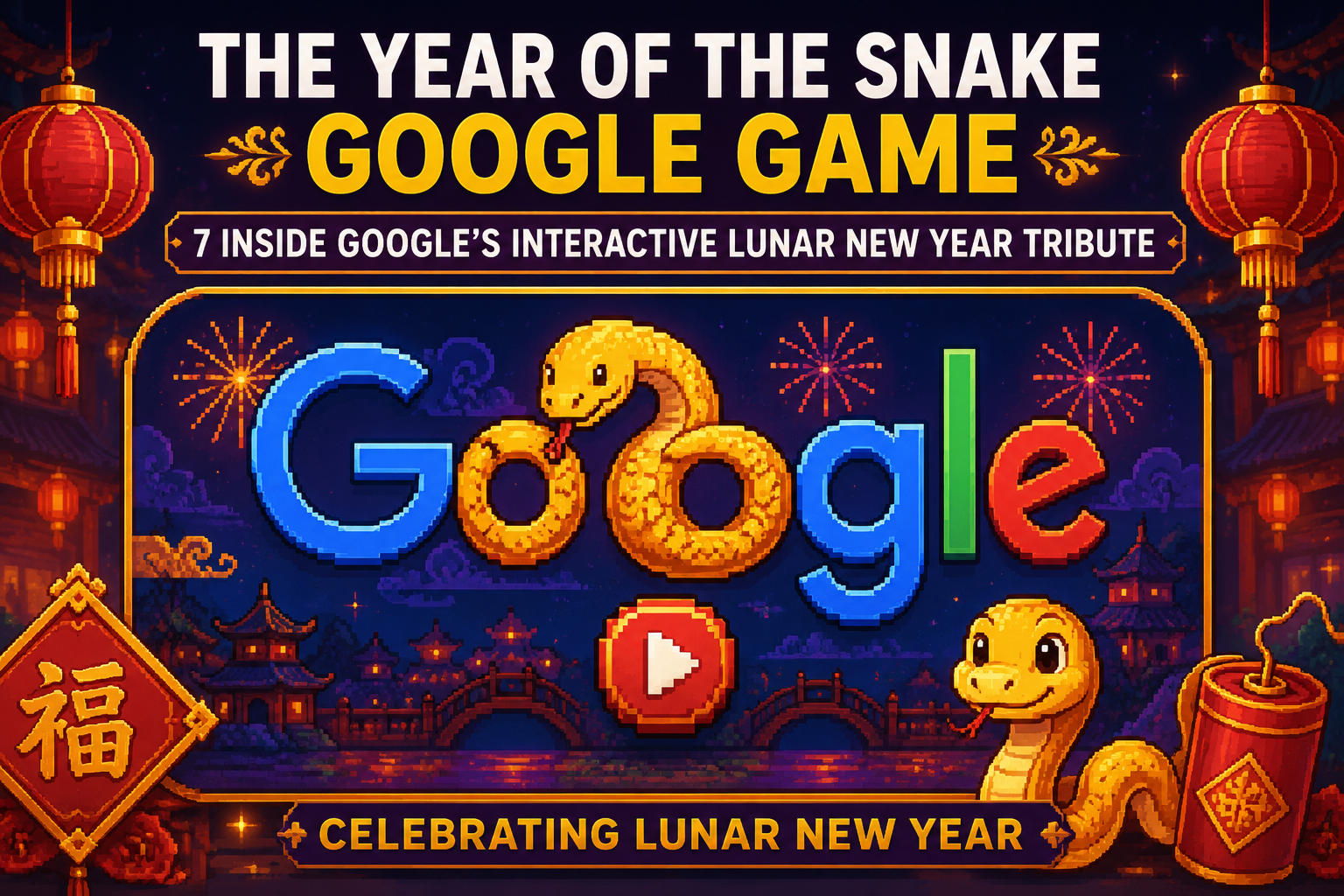
On January 29, 2025, millions of users worldwide opened their browsers to find a familiar yet fresh surprise. The Google homepage had transformed, trading its minimalist logo for an animated serpent weaving through festive red lanterns and golden citrus fruits. This wasn’t just another holiday-themed illustration—it was an invitation. A click transported users into a fully playable game that merged the beloved mechanics of a classic arcade title with the rich symbolism of the Lunar New Year. The Year of the Snake Google game had arrived, capturing global attention and offering a moment of joyful nostalgia in an increasingly complex digital world.
Why Google Chose an Interactive Doodle for the Year of the Snake
Google has long used Doodles to celebrate cultural milestones, and the Lunar New Year is one of its most anticipated annual observances. The first new moon of the lunar calendar has been celebrated for over 3,000 years across China, South Korea, Vietnam, and other Asian nations . For 2025, the choice of the Snake—the sixth animal in the Chinese zodiac—held particular resonance. In astrological tradition, the Snake symbolizes wisdom, transformation, and strategic thinking . By creating an interactive experience rather than a static image, Google transformed a cultural greeting into a participatory event, allowing users to engage with the symbolism of growth and renewal through gameplay. The Doodle artwork itself came from South Korean collaborators, reflecting the pan-Asian nature of the celebration .
How the Year of the Snake Google Game Elevates a Classic
For those who remember the pixelated serpent navigating monochrome phone screens in the late 1990s, the Year of the Snake Google game offered a wave of nostalgia. However, this was far from a simple rehash. While the core objective remained familiar—guide your snake to consume items and grow while avoiding walls and your own expanding tail—Google introduced several modern enhancements . Players could personalize their snake’s appearance and customize the look of its snacks, adding a layer of ownership to the experience. The inclusion of unique daily challenges transformed a casual diversion into a game with enduring appeal, encouraging players to return day after day to tackle new objectives .
Accessing the Game: A Seamless Browser Experience
One of the most appealing aspects of the Year of the Snake Google game was its accessibility. In an era of heavy app downloads and complex installations, Google returned to the simplicity of the browser. No downloads were required; the game launched instantly from the Google homepage. To access it, users simply navigated to Google.com and clicked on the animated Doodle banner. For those who missed the live event, the game remained accessible through the Google Doodle archives . This frictionless entry point was key to its widespread adoption, as it allowed users of all ages and technical abilities to participate in the celebration with a single click.
Cultural Significance of the Lunar New Year Doodle
The visual design of the Doodle was steeped in cultural meaning. The snake was depicted alongside a mandarin orange, a fruit traditionally consumed during Lunar New Year festivities as a symbol of luck and prosperity . The background’s red hue referenced the red envelopes, known as hongbao in Mandarin, that are gifted to symbolize good fortune and the passing of another year . The Doodle also acknowledged regional variations: in South Korea, the celebration is known as Seollal, with traditions including sebae (paying respects to elders) and games like yunnori . By weaving these specific cultural touchpoints into the game’s aesthetic, Google demonstrated a nuanced understanding of the holiday beyond a simple aesthetic overlay.
Gameplay Mechanics: How to Master the Snake
The controls for the Year of the Snake Google game were designed for universal accessibility. On desktop computers, players used the arrow keys—up, down, left, and right—to guide their serpent. For mobile users, the experience was equally intuitive, utilizing swipe gestures to direct the snake’s path across the screen . The challenge escalated as the snake grew longer, making navigation increasingly precarious. Strategic play was essential: experienced players learned to plan their routes, use the edges of the playing field for efficient turns, and maintain calm composure as the game’s speed gradually increased . This blend of simple controls and escalating difficulty created the “just one more try” loop that defines addictive gameplay.
The 3,000-Year Tradition Behind the Celebration
To fully appreciate the game, it is helpful to understand the depth of the tradition it honors. The Lunar New Year is not merely a single day but a season of renewal. Its origins trace back over three millennia to agrarian societies that marked the new moon as the start of a new agricultural cycle . Families clean their homes to sweep away ill fortune and decorate with red couplets and lanterns to invite good luck. Festivities often include lighting firecrackers to ward off the mythical beast Nian, who was said to be frightened by loud noises . These customs, observed across China, South Korea, Vietnam, and the global diaspora, represent a shared cultural heritage that the Google Doodle aimed to celebrate on a global scale.
Google Doodles and Their Impact on Cultural Awareness
Google Doodles have evolved from simple logo alterations into powerful cultural touchpoints. In 2010, the introduction of a playable Pac-Man Doodle set a new standard, reportedly costing the world millions of hours of productivity as users engaged with the interactive element . This event demonstrated that Doodles could transcend passive viewing and become active engagements. Research indicates that Doodles significantly increase search volume and public interest in their subjects, with some historical figures experiencing a 33-fold increase in traffic to related pages . The Year of the Snake game continued this legacy, serving as both an educational tool and a moment of global unity through shared play.
Personalization and Daily Challenges: A Modern Twist
One of the standout features of the Year of the Snake Google game was its move toward personalization. Rather than a one-size-fits-all experience, players could customize their serpent, making the experience more personal and engaging . The introduction of daily challenges provided a compelling reason to return, shifting the gameplay from a single-session novelty into a habit-forming interaction. These challenges, which introduced new objectives beyond the traditional “eat and grow” formula, kept the experience fresh . This update demonstrates Google’s understanding of modern gaming habits, where players increasingly seek variety, achievement, and community.
Historical Context: The Snake Game Legacy
The snake game concept has a storied history in the digital world. Originating in the arcade with titles like Blockade in 1976, the concept found its way to personal computers and gained massive popularity when Nokia pre-installed a version on its mobile phones in 1998 . The game’s enduring appeal lies in its elegant simplicity: easy to understand but difficult to master. This history made it the perfect vehicle for the Year of the Snake Doodle. By tapping into a collective memory of late-night gaming sessions, Google successfully bridged generational gaps. A grandparent who played the game on a Nokia phone could share the experience with grandchildren accessing it through a modern browser.
Visual Design and Thematic Connection to Lunar New Year
The artistic direction of the Doodle effectively conveyed the festive spirit of the holiday. The snake motif was rendered in a stylized, non-threatening manner appropriate for the occasion. The incorporation of lanterns, red and gold color palettes, and traditional symbols created a cohesive visual narrative . The game interface likely took cues from the physical act of decorating: bright, celebratory, and warm. This visual storytelling is a crucial component of the Doodle’s success, as it embeds the gameplay within a meaningful context. It transforms a simple interaction into a visually rich exploration of a cultural event, helping to educate players about the festival’s aesthetics.
Worldwide Reach and Regional Variations
The Year of the Snake Google game was not a single, monolithic experience. Recognizing the diverse ways Lunar New Year is celebrated, Google released localized versions. While the primary game celebrated the Year of the Snake globally, a separate Doodle was dedicated specifically to South Korea, highlighting traditions such as ttoekguk (rice cake soup) and the board game yunnori . This regional specificity demonstrates a sophisticated understanding of the cultural landscape. It acknowledges that while Lunar New Year is a shared event, its expression varies across nations. Such attention to detail enhances Google’s credibility and trustworthiness as a global cultural curator.
The Role of Nostalgia in the Game’s Success
The success of the Year of the Snake Google game can be partially attributed to its skillful deployment of nostalgia. In a fast-paced, high-tech environment, the simple, retro mechanics of the snake game offered a calming respite. It recalled a time when mobile gaming was defined by the constraints of a small LCD screen and the challenge of achieving a high score . This nostalgic appeal was powerful enough to cut through the noise of modern digital entertainment. It provided a shared cultural reference point, enabling conversation across generations and reminding users of the joy found in uncomplicated gameplay.
How the Game Compares to Previous Interactive Doodles
Google has a rich history of interactive Doodles, from the aforementioned Pac-Man to coding games for children. The Year of the Snake game stands out for its balance of innovation and fidelity to the source material. Unlike some Doodles that are purely educational, this game prioritized fun and accessibility while integrating cultural education . It sits alongside previous interactive successes by offering a polished, replayable experience that likely increased user engagement and dwell time on the Google homepage, similar to the phenomenon observed with the Pac-Man Doodle . However, its integration of daily challenges and personalization features represents an evolution toward more sustained engagement.
Future of Interactive Cultural Celebrations in Tech
The Year of the Snake Google game offers a glimpse into the future of digital cultural celebrations. As search engines and tech platforms evolve, the use of interactive experiences to mark cultural events is likely to become more sophisticated. We can anticipate deeper personalization, integration with social sharing features, and perhaps even connections to AI-driven companions. The success of this Doodle shows that users value experiences that are culturally rich and emotionally resonant. As platforms compete for attention in an AI-driven search landscape, these human-centric, interactive moments will become increasingly valuable. They transform a routine action—opening a browser—into a moment of discovery and delight.
Key Takeaways
- Interactive Cultural Celebration: The Year of the Snake Google game, launched on January 29, 2025, transformed a traditional Lunar New Year Doodle into a playable experience that celebrated the holiday’s themes of growth and transformation .
- Modernized Classic Gameplay: While honoring the classic Snake arcade game, Google introduced personalization options and daily challenges, elevating the experience beyond simple nostalgia .
- Rich Cultural Authenticity: The Doodle’s design, incorporating red envelopes, mandarin oranges, and regional South Korean traditions, demonstrated deep cultural sensitivity and knowledge .
- Seamless Accessibility: The game required no download and was accessible via the Google homepage, making it easy for a global audience to participate immediately .
- Proven Engagement Strategy: Building on past successes like the Pac-Man Doodle, this interactive game successfully captured user attention and highlighted the power of play in education and brand engagement .
- Bridging Generations: By leveraging the nostalgic appeal of the snake game, Google connected younger users with older generations who remembered the game from early mobile phones .
Frequently Asked Questions
What is the Year of the Snake Google game?
The Year of the Snake Google game is an interactive Doodle launched by Google on January 29, 2025, to celebrate the Lunar New Year. It is a modernized version of the classic Snake arcade game, redesigned with fresh visuals and updated gameplay .
How do you play the Year of the Snake Google game?
Players control a snake using arrow keys on a keyboard or swipe gestures on a touchscreen. The objective is to eat items to grow longer while avoiding collisions with walls or the snake’s own tail. The game ends upon collision .
Is the Year of the Snake Google game still available to play?
The game was available on the Google homepage during the Lunar New Year celebrations. Users can often find archived versions of Google Doodles by searching the Google Doodle archives to access past interactive games .
What is the cultural significance of the Year of the Snake?
In the Chinese zodiac, the Snake symbolizes wisdom, transformation, and strategic thinking. The Year of the Snake, which began in 2025, is considered a time for growth, creativity, and calculated progress .
What are the daily challenges in the game?
The Year of the Snake Google game introduced daily challenges that offered new objectives beyond the standard gameplay. These challenges encouraged repeat play and added variety to the experience .
Why does Google create interactive Doodles for holidays?
Google creates Doodles to celebrate significant cultural events, holidays, and historical figures. Interactive Doodles engage users by providing a memorable, participatory experience that educates and entertains .
Conclusion: A Serpentine Path to Celebration
The Year of the Snake Google game was more than a clever marketing tactic; it was a digital celebration that united millions through play. By seamlessly blending a beloved classic game with the profound traditions of the Lunar New Year, Google created a moment of collective joy and cultural appreciation. It reminded us that in our increasingly digital lives, there is still immense value in simple, shared experiences. The game served as a bridge—between generations, between cultures, and between the past and the present. As we look toward future tech-driven cultural celebrations, the success of this Doodle offers a clear path forward: one that prioritizes authenticity, accessibility, and the enduring power of play. Whether you joined the fun on January 29 or discovered it later through the archives, the invitation to celebrate growth, transformation, and community remains open. Explore the Doodle archives, and take a moment to appreciate the blend of art, culture, and technology that made this celebration possible.
You Mey Olso Read
The Chopped Meaning Slang: 7 Incredible Facts Every Internet User Should Know
