

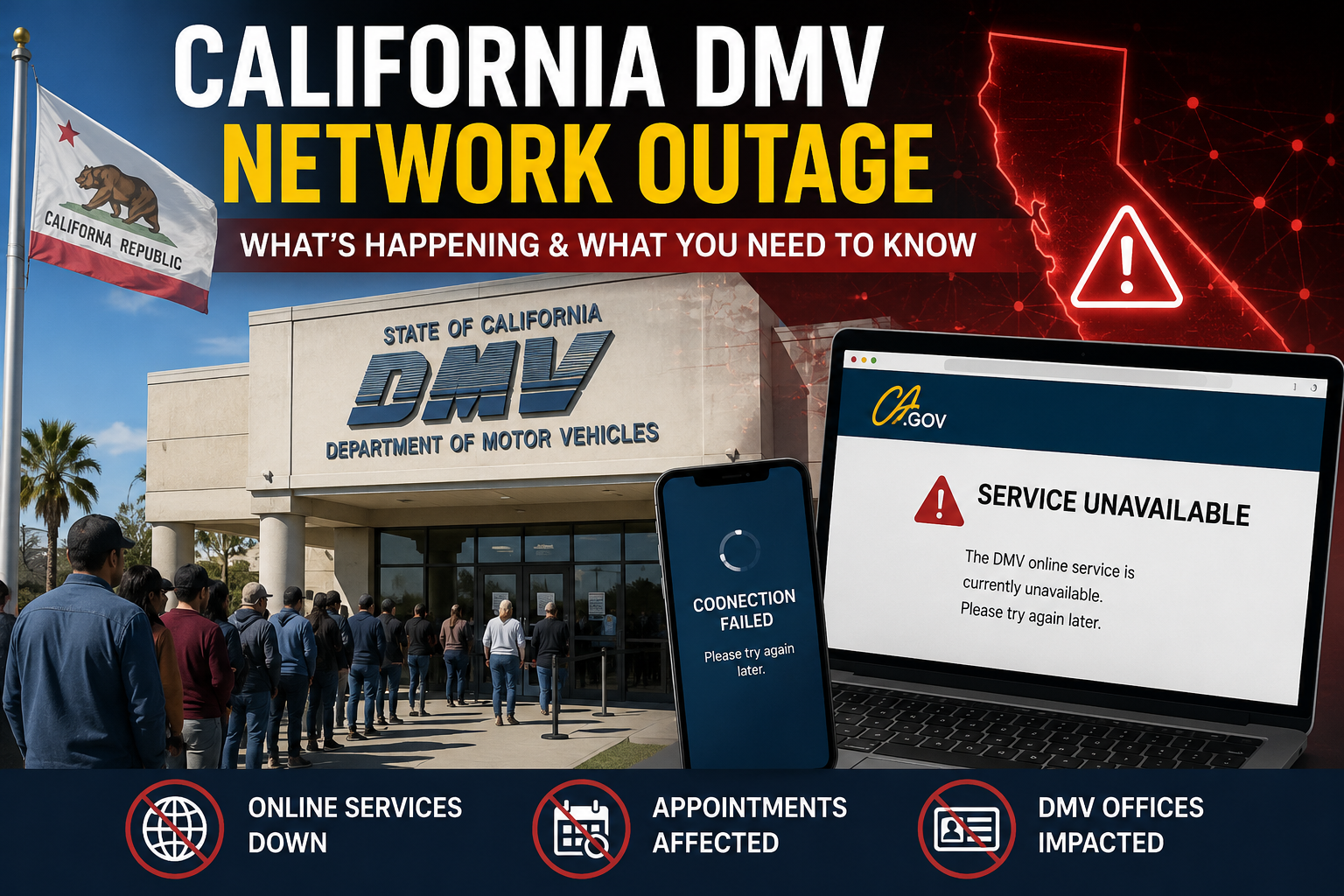
The California Department of Motor Vehicles handles more than 22 million licensed drivers and processes over 30 million transactions annually. For three consecutive days in late March, many of those services ground to a halt. Customers walked into field offices ready to renew licenses or register vehicles, only to discover the computer systems they depended on were effectively useless—at least for certain critical tasks. One frustrated visitor at a Los Angeles-area office captured the mood perfectly: “DMV网坏了…现在更新不了驾照,只能做车牌的更新.” Their experience wasn’t isolated; it was part of a broader disruption that left countless Californians trapped in bureaucratic limbo.
The California DMV network outage exposed a vulnerability that many residents have long suspected but never confirmed so plainly: the DMV’s digital infrastructure is fragile, and when it fails, real people pay the price. For those holding driver’s licenses, particularly individuals on temporary visas, the stakes were even higher. Without functioning systems, license renewals could not proceed, creating potential legal and practical complications for people who rely on valid identification to work, travel, and navigate daily life. The California DMV network outage wasn’t merely inconvenient—it was a window into a larger crisis facing one of the state’s most essential public agencies.
The Scope of the Recent California DMV Network Outage
The network disruption that began in late March 2026 wasn’t a brief hiccup. It persisted for days, with systems “一会好一会不好”—sometimes functional, sometimes not. This intermittent service pattern created confusion for both customers and staff. People who had scheduled appointments weeks in advance often found themselves turning around and heading home, their valuable time wasted. Others, hoping the systems might come back online during their visit, lingered in crowded lobbies only to leave empty-handed. The California DMV network outage created chaos across multiple field offices simultaneously.
What made this particular disruption especially damaging was its selective nature. Certain services remained accessible while others were completely blocked. Vehicle registration updates appeared to function normally, but driver’s license processing—particularly the critical step of capturing new photographs—was entirely unavailable. For individuals whose licenses had expired or were nearing expiration, this wasn’t a minor inconvenience. It meant weeks or months of additional waiting, with no guarantee that the systems would be stable when they returned. This California DMV network outage specifically targeted the most time-sensitive transactions.
Behind the Scenes: What Causes DMV System Failures
The underlying causes of California DMV network outage events typically trace back to aging infrastructure, insufficient maintenance budgets, and the enormous scale of California’s population. With over 39 million residents, the state’s DMV operates one of the most complex motor vehicle bureaucracies in the world. Yet the technology supporting this operation often lags far behind what modern users expect. When thousands of people attempt to access the same systems simultaneously—particularly during peak periods like the end of the month or the start of a new quarter—the strain can overwhelm aging servers and trigger another California DMV network outage.
Technical experts point to a combination of factors that contribute to these disruptions. Legacy software that hasn’t been modernized, insufficient cloud backup capacity, and a shortage of specialized IT personnel all play roles. The DMV has made progress in recent years, implementing online services and attempting to reduce in-person wait times, but these advances have also created new vulnerabilities. When digital systems fail, there’s often no functional alternative, leaving both staff and customers powerless until the technology is restored. Each California DMV network outage follows this same predictable pattern.
The Human Impact on California Drivers
The California DMV network outage hit some Californians harder than others. For U.S. citizens with standard licenses, delays were frustrating but manageable. For those on temporary visas or other limited-term documentation, the stakes were existential. Their ability to drive legally hinges on maintaining a valid license, and when systems fail, they have no recourse. One visitor described their experience trying to renew a license tied to a travel visa, explaining that the photo capture system was down and there was simply no way to complete the process. They were told to return in a few days and try again—an uncertain proposition given the intermittent nature of the service.
Beyond the immediate practical challenges, this California DMV network outage created broader social and economic costs. People missed work because they had to spend hours at DMV offices. Businesses lost productivity when employees could not drive legally. Families faced disruptions when parents could not pick up children from school because their licenses had expired and they could not renew them. The cumulative effect of a multi-day network failure extended far beyond the DMV lobbies themselves, rippling through communities and affecting thousands of lives.
11,000 Licenses at Risk: The Broader DMV Crisis
The March network disruption did not occur in isolation. It followed closely on the heels of another alarming development: the DMV’s announcement that it would cancel approximately 11,000 driver’s licenses and require those drivers to retake written tests within 30 days. The agency refused to explain why these specific licenses were targeted, creating widespread anxiety among affected drivers. Many learned about their license status only through notification letters, with minimal time to prepare for the retesting requirement. This California DMV network outage compounded the anxiety already surrounding these license cancellations.
This combination of events—a multi-day network failure followed by mass license cancellations—has shaken public confidence in the DMV’s ability to manage its core responsibilities. The lack of transparency around the cancellations has been particularly damaging. Drivers affected by the order have expressed confusion, anger, and fear, with many questioning whether the California DMV network outage somehow caused or contributed to the licensing issues. The DMV’s silence on these matters has only deepened public distrust.
Why California DMV Systems Struggle to Keep Pace
California’s DMV faces a fundamental challenge: it must serve a population larger than that of many countries, using technology that was designed for a much smaller era. The department processes more than 30 million transactions annually, managing everything from new driver licenses and vehicle registrations to commercial permits and identification cards. This workload would strain even the most modern systems. When that workload is combined with outdated infrastructure, the results are predictable—frequent failures, slow response times, and frustrated customers. The California DMV network outage in March was merely the latest example of this systemic problem.
Budget constraints have historically limited the DMV’s ability to invest in system upgrades. The department has received increased funding in recent years for modernization efforts, including a long-term plan to move many services online. However, these transitions take time, and during the interim period, the legacy systems that remain in place are more vulnerable than ever. When something fails, repairs are complicated by the fact that fewer and fewer technicians understand the aging software and hardware still in use. Until these upgrades are complete, the risk of another California DMV network outage remains high.
How Other States Handle Motor Vehicle Technology
California isn’t alone in struggling with DMV technology issues. States across the country have grappled with similar challenges, and some have found innovative solutions. Colorado, for example, overhauled its DMV system in phases, beginning with high-volume services like vehicle registration and gradually moving to more complex functions like driver’s license processing. The phased approach allowed the state to identify and fix problems before they could cause widespread disruptions. These strategies offer lessons for California as it works to prevent the next California DMV network outage.
Texas adopted a different strategy, investing heavily in cloud-based infrastructure that can automatically scale up during peak demand periods. This flexibility helps prevent system overloads during busy seasons. Florida focused on mobile-first solutions, enabling residents to complete most DMV transactions without ever visiting an office. California has studied these models, but implementing similar changes across the state’s enormous and diverse population presents unique difficulties. What works in a smaller state may not translate effectively to California’s scale, leaving the state vulnerable to future California DMV network outage events.
Historical Context: DMV Disruptions Through the Years
The current network failure is hardly the first technological problem to plague California’s DMV. The department has a long history of system issues, dating back to early efforts to computerize operations in the 1960s and 1970s. Each generation of technology has brought new capabilities but also new vulnerabilities. The transition to real-time online services in the 2000s, while beneficial, introduced reliability issues that previous batch-processing systems never experienced. The pattern of California DMV network outage events has persisted across decades.
Throughout the years, the pattern has remained consistent: system improvements are proposed, partially funded, and never fully realized. Competing priorities, changing administrations, and the sheer complexity of the task have all contributed to this cycle. Each new outage highlights the same underlying problems, yet comprehensive solutions remain elusive. The March 2026 incident serves as another reminder that without sustained investment and political will, these disruptions will continue. Breaking this cycle requires learning from past California DMV network outage events.
Technology Modernization Efforts Underway
Despite the challenges, the California DMV has made tangible progress toward modernizing its systems. A multi-year initiative has brought many services online, reducing the need for in-person visits and making routine transactions more convenient. The department has also implemented new photo capture technology and digital record-keeping systems designed to improve accuracy and efficiency. However, as the recent California DMV network outage demonstrates, the transition is far from complete and vulnerabilities remain.
The modernization effort faces constant pressure from both budget limitations and the enormous volume of transactions the DMV processes. Upgrading systems while continuing to serve millions of customers creates a delicate balancing act. When something goes wrong, the consequences are immediate and visible, which can undermine public support for the modernization process itself. Yet the alternative—continuing with outdated infrastructure—is unsustainable. The recent California DMV network outage has accelerated calls for faster action.
Practical Steps for Affected Drivers
If you’re caught in a California DMV network outage, there are several steps you can take to minimize the disruption. First, check the DMV’s website and social media channels for status updates. The department often posts information about service interruptions and provides guidance on which services remain available. Second, if possible, postpone non-urgent transactions until systems are confirmed to be stable. Vehicle registration renewals, for example, may be possible online even when other services are unavailable. Staying informed is your best defense against a California DMV network outage.
Third, document everything. If you visit an office and cannot complete your transaction due to system issues, ask for written confirmation of the date and nature of the problem. This documentation may be useful if you face penalties for late registration or other violations. Fourth, consider alternative DMV offices. In some cases, the California DMV network outage is localized, and a nearby field office may still be able to process your transaction. Finally, contact your state assembly member or senator’s office if you encounter ongoing problems. Elected officials often have constituent services staff who can intervene with agencies on your behalf.
Future Outlook: Will the Outages Continue?
The outlook for California DMV system reliability is mixed. In the short term, similar disruptions are likely to occur as the department continues to transition to newer technology. Each phase of the modernization process introduces new risks, and some failures are inevitable. However, the long-term trajectory is positive. As old systems are retired and replaced, the overall reliability of the DMV’s infrastructure should improve, reducing the frequency of California DMV network outage events.
The department has shown a greater willingness to invest in technology, and public pressure following incidents like the March 2026 California DMV network outage may accelerate these efforts. Future innovations could include better backup systems, more robust disaster recovery plans, and improved customer communication during disruptions. Nonetheless, Californians should expect occasional system failures for the foreseeable future and plan accordingly. Technology is never perfect, and the DMV’s complex operations will always face some risk of another California DMV network outage.
Key Takeaways
- The March 2026 California DMV network outage lasted at least three days and prevented critical services like driver’s license renewals that required photo capture
- Vehicle registration services remained functional during the California DMV network outage, while other services were intermittently unavailable
- The outage occurred alongside the DMV’s controversial decision to cancel approximately 11,000 driver’s licenses without clear explanation
- Drivers on temporary visas faced particular hardship because they could not complete required renewals during the California DMV network outage
- Aging infrastructure and massive transaction volumes contribute to ongoing system vulnerabilities
- The DMV is working on modernization, but the transition period will likely see continued disruptions
- Affected drivers should document their experiences and check official sources for status updates
Frequently Asked Questions
What caused the recent California DMV network outage?
The exact cause hasn’t been publicly confirmed, but experts point to aging infrastructure, system overload from high transaction volumes, and the ongoing transition to new technology. The California DMV network outage began in late March 2026 and continued intermittently for at least three days.
Which services were affected by the California DMV network outage?
Driver’s license renewals that required new photo capture were most affected. Vehicle registration updates appeared to continue functioning. The systems were “一会好一会不好” (sometimes working, sometimes not), making it unpredictable which services would be available during the California DMV network outage.
How long did the California DMV network outage last?
The disruption continued for at least three consecutive days, starting in late March 2026. Customers reported the system had been down for three days, and the intermittent nature meant some days saw partial service while others experienced complete failure during the California DMV network outage.
Why can’t the DMV fix these problems permanently?
The DMV operates with outdated infrastructure that’s expensive and complicated to replace. Modernization requires substantial funding and careful planning to avoid causing even more significant disruptions. The department is working on improvements, but progress is gradual, and another California DMV network outage remains possible.
What should I do if I need a license renewal during a California DMV network outage?
Check the DMV website for status updates first. If you must visit an office, bring all required documents and be prepared for the possibility that you’ll need to return. Document your visit, including the date and reason for the delay, in case penalties apply later.
Are there alternatives to visiting a DMV office during a California DMV network outage?
Some services may be available through the DMV’s website, third-party partners, or other channels. Vehicle registration renewals, for example, might still be processed even when license services are down. Check what’s available online before visiting an office.
Will there be more California DMV network outage events in the future?
Experts suggest that until the DMV completes its technology modernization, some level of risk remains. The department is working to improve stability, but drivers should stay informed and prepared for possible future disruptions.
Conclusion
The California DMV network outage of March 2026 represents more than just an inconvenience for millions of drivers. It is a symptom of a deeper crisis in the state’s ability to maintain critical infrastructure that touches nearly every resident’s life. While the department has made commendable progress toward modernization, the transition period remains rocky, with failures that disrupt lives and erode public trust. The simultaneous license cancellations affecting 11,000 drivers only amplify these concerns, raising questions about the DMV’s competence and transparency.
For Californians, the takeaway is clear: be prepared for continued system disruptions and take proactive steps to protect yourself. Stay informed through official channels, document your interactions with the DMV, and consider reaching out to elected representatives if you encounter serious problems. The Department of Motor Vehicles is working to improve its systems, but in the meantime, patience and preparation are your best defenses against the frustrations of a California DMV network outage. If you have been affected by these disruptions, share your experience with your local assembly member or senator to help drive the political pressure needed for real, lasting change.
You Mey Olso Read
License Plate Lookup Texas: 7 Shocking Facts Every Driver Should Know
