

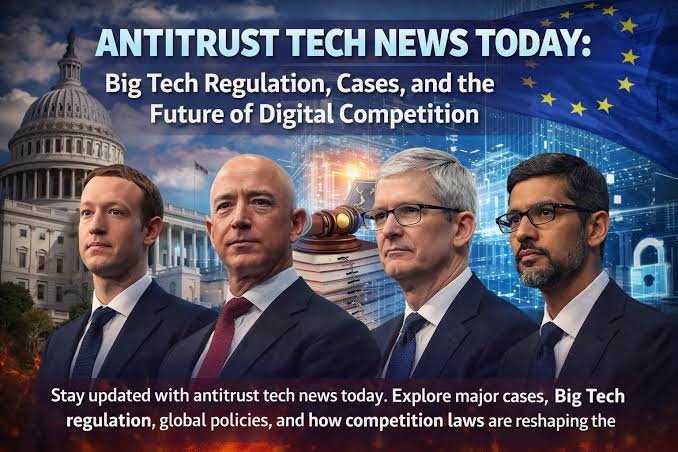
The world’s most powerful technology companies are facing a reckoning. In a landmark ruling that will reverberate through boardrooms and government agencies worldwide, the European Union’s top court dismissed Google’s final appeal against a record $4.5 billion antitrust fine on July 2, 2026. The decision marks the end of an eight-year legal battle over the dominance of its Android operating system and represents a pivotal moment in antitrust tech news today, confirming that the era of unfettered growth for digital giants may be drawing to a close. This isn’t just a story about one company; it is a signal of a global shift in how we view the immense power of these digital platforms.
The ruling lands at a critical juncture. Regulators are no longer just talking about the need for change; they are actively reshaping the competitive landscape. From the United States to India, a confluence of court decisions, new legislation, and aggressive enforcement actions are fundamentally altering the rules of the game for the tech industry. We are moving from a period of investigation to one of active remedy, and the impact on consumers, developers, and the future of innovation will be profound. This article delves into these recent developments, offering a comprehensive overview of a world where Big Tech’s dominance is no longer taken for granted.
The Google Android Verdict: A Precedent for the Digital Age
The European Court of Justice’s decision to uphold the €4.1 billion fine against Google is more than just a financial penalty; it is a resounding affirmation of the EU’s regulatory authority. The court confirmed that Google abused its dominant position by using the Android operating system, which powers the vast majority of the world’s smartphones, to cement the primacy of its own search engine. This practice shut out competitors and reduced consumer choice, violating the bloc’s strict competition rules. Agustín Reyna, director general of the European Consumer Organization, hailed the ruling as “a big win for Europe” and a clear message that dominant companies cannot use their power to stifle competition.
This verdict is the culmination of over a decade of tension between U.S. tech behemoths and European regulators, who have positioned themselves as the world’s most aggressive enforcers of digital competition. Google has now accumulated nearly €11 billion in EU antitrust fines over the past decade, and this ruling is expected to embolden regulators in other jurisdictions. While Google has made changes to its Android practices since the initial 2018 ruling, the court’s dismissal of its appeal suggests that these adjustments were insufficient to undo the initial harm to the market. The case serves as a powerful precedent for future enforcement, demonstrating that lengthy legal battles will not deter the EU from its mission to create a fairer digital marketplace.
The New Frontier: The U.S. DOJ Targets Apple’s Ecosystem
While the EU has been leading the charge in antitrust enforcement, the United States is rapidly catching up. A key development in antitrust tech news today is the U.S. Department of Justice’s (DOJ) case against Apple. In a significant blow to the tech giant, a federal district court in New Jersey denied Apple’s motion to dismiss the DOJ’s antitrust claims in June 2025. The court found that the government adequately alleged that Apple holds a monopoly in the U.S. smartphone market and engaged in anti-competitive conduct by constructing technological barriers to stifle competition.
The DOJ’s case revolves around Apple’s “walled garden” approach, where it restricts the use of certain technologies to keep users and developers locked into its ecosystem. The court noted allegations that Apple limits “super apps,” degrades the functionality of non-Apple smartwatches, and blocks third-party digital wallets from offering alternatives to Apple Pay. These actions, the plaintiffs argue, are not about security, but about protecting Apple’s monopoly and harming consumers. This case is a bellwether for U.S. antitrust enforcement, signaling a willingness to go after the very design of a company’s products if it serves to entrench its power.
A Global Crackdown: From India to Australia
The regulatory pressure on Big Tech is not confined to the U.S. and the EU; it is a truly global phenomenon. In India, Apple is locked in a heated battle with the Competition Commission of India (CCI). Apple has accused Indian investigators of “copy-pasting” arguments from its rivals, such as Match Group, instead of conducting their own independent analysis. The company has argued that its market share in India is under 6%, making it a “minuscule player” and questioning the basis for the antitrust claim. However, the CCI’s case is progressing, with a hearing scheduled for July 21, 2026.
Elsewhere, Australia has taken a stand against Amazon. The Australian Competition and Consumer Commission (ACCC) filed a lawsuit against the tech giant in June 2026, accusing it of imposing unfair contract terms on more than 1 million users of its Prime streaming service. This follows another ACCC lawsuit against Amazon in May 2026 over the sale of non-compliant children’s backpacks. Meanwhile, the Philippine Competition Commission (PCC) is also refining its approach to digital markets, issuing guidelines to review mergers and acquisitions and conducting market studies on digital platforms. These actions demonstrate a worldwide consensus: the power of the tech giants must be scrutinized and checked to protect national interests and consumer welfare.
The “Gatekeeper” Economy and the EU’s Digital Markets Act
Central to the EU’s strategy is the Digital Markets Act (DMA), a sweeping piece of legislation that designates certain tech companies as “gatekeepers” and imposes a series of “dos and don’ts” on their operations. In a related development, the EU’s High Court upheld Apple’s designation as a gatekeeper for its iOS operating system and the App Store, rejecting the company’s appeal. This ruling, which came on July 8, 2026, is a significant victory for the EU, as it forces Apple to comply with stringent rules designed to open up its ecosystem to competitors.
The DMA, alongside the Digital Services Act (DSA), has transformed the EU into a massive regulatory laboratory for the digital economy. The legislation is already having an impact. In one notable case, the EU ordered Meta to give rival AI chatbots free access to its WhatsApp platform as part of an antitrust probe, a move Meta has said it will appeal. The law has been criticized by the U.S. government, with former President Trump threatening 100% tariffs on EU goods in retaliation for what he sees as unfair targeting of U.S. companies. This geopolitical tension underscores the high stakes involved in this new era of digital regulation.
Key Takeaways
- The Era of “Too Big to Regulate” Is Over: The unprecedented level of global enforcement against tech giants shows that no company is above the law, a sentiment echoed by U.S. Deputy Attorney General Lisa Monaco.
- Regulatory Frameworks Are Reshaping the Industry: The EU’s DMA and DSA are providing the blueprint for a new, more regulated digital world, inspiring similar efforts globally, from Australia to the Philippines.
- Data and Ecosystems Are the New Battlegrounds: Antitrust cases are no longer just about price-fixing. The core of the modern conflict is about control over data, user ecosystems, and the technological barriers that lock consumers in.
- Innovation vs. Regulation Is a False Dichotomy: While some argue that strict antitrust enforcement stifles innovation, regulators and consumer groups counter that fair competition is essential for a dynamic and innovative market that serves the public interest.
A Diverging Future: Innovation vs. Regulation?
The global crackdown on Big Tech has sparked a fierce debate about the balance between regulation and innovation. Proponents of strict enforcement, like the EU, argue that breaking down monopolies and “gatekeepers” is essential to foster competition, lower prices, and protect consumer choice. They point to the success of Europe’s regulatory framework as a model that prioritizes fairness and democratic values over the unbridled power of corporate interests. The court’s ruling against Google in the Android case is a clear validation of this approach.
However, critics, including Apple and some U.S. policymakers, warn that heavy-handed regulation could have unintended consequences. They contend that forcing companies to open their platforms and share their technologies could harm security and privacy and, more importantly, blunt the competitive edge of American innovation. A 2023 study from the Competitive Enterprise Institute even concluded that stricter antitrust enforcement could harm economic growth and ultimately cause the U.S. to fall behind the rest of the world. This debate will likely intensify as the U.S. and the EU navigate their diverging paths in the years ahead.
Looking Ahead: The AI Monopoly Question
As the legal battles over legacy platforms like search and app stores rage on, a new and potentially more consequential antitrust challenge is already emerging: artificial intelligence. The power to develop and deploy advanced AI is concentrated in the hands of the very same tech giants currently under the regulatory microscope—Alphabet, Amazon, Apple, Meta, and Microsoft. This group is now seen as a “monopoly group” that controls the infrastructure of the digital economy, and by extension, the future of AI.
The concern is that these companies, already in possession of vast troves of data and immense computing power, will use AI to further entrench their dominance. Governments around the world are waking up to this threat. In Australia, Prime Minister Anthony Albanese has warned that failure to set rules for AI would mean “subcontracting our sovereignty and security to the control of foreign monopolies”. The Stanford Computational Antitrust Project, an initiative bringing together over 80 competition agencies, is already working on building tools and legal frameworks to address the challenges of fast-evolving markets, including those dominated by AI. The next frontier in antitrust tech news today and in the future will undoubtedly be about who gets to build and control the intelligent algorithms that will shape our world.
FAQ
What was the EU’s $4.5 billion antitrust fine against Google for?
The European Union’s top court fined Google a record $4.5 billion for abusing the dominant position of its Android mobile operating system. Regulators found that Google used Android to force phone manufacturers to pre-install its search engine and Chrome browser, thereby shutting out competitors and limiting consumer choice.
What is the U.S. Department of Justice’s antitrust case against Apple about?
The DOJ alleges that Apple has illegally maintained a monopoly over the U.S. smartphone market. The case focuses on Apple’s anti-competitive practices, such as limiting “super apps,” blocking cloud-streaming game apps, and restricting cross-platform messaging and digital wallets to keep users locked into its ecosystem.
What is the EU’s Digital Markets Act?
The Digital Markets Act (DMA) is a landmark piece of EU legislation that designates certain large tech platforms as “gatekeepers”. It imposes a list of obligations and prohibitions on these companies to ensure fair competition and prevent them from abusing their dominant position in the digital economy.
How is India responding to Big Tech’s dominance?
The Competition Commission of India (CCI) is actively investigating companies like Apple and Google for alleged anti-competitive practices. Apple is currently fighting an investigation that accuses it of abusing its position on the iOS App Store by forcing developers to use its proprietary payment system.
Is antitrust enforcement hurting innovation?
This is a subject of significant debate. Proponents argue that enforcement fosters competition, which drives innovation. Critics, however, contend that heavy-handed regulation can stifle growth, harm security, and cause the U.S. to fall behind in the global tech race.
Conclusion: A Paradigm Shift in the Digital World
The landscape of the technology industry is undergoing a profound transformation. The flurry of legal defeats, regulatory probes, and new legislation impacting Google, Apple, Meta, and Amazon marks a clear paradigm shift. The long-held belief that these companies were too powerful to be effectively regulated has been shattered. Today, antitrust tech news is dominated by stories of governments asserting their authority and demanding a fairer, more competitive digital marketplace.
For consumers and developers, this could mean more choice, lower prices, and greater opportunities. For the tech giants, it signals the end of an era of unchecked expansion. The coming years will be defined by a delicate dance between governments seeking to protect their citizens and economies, and tech companies fighting to preserve their business models. The outcome of these battles will determine the very nature of the digital world we will inhabit for decades to come.
Stay informed on these crucial developments. The balance of power in the digital age is being decided right now. Share this article to keep the conversation going and subscribe to our newsletter for daily updates on the stories that matter.
You Mey Olso Read
FTC AI News: The New Crackdown on AI Accuracy and Ideological Steering
