

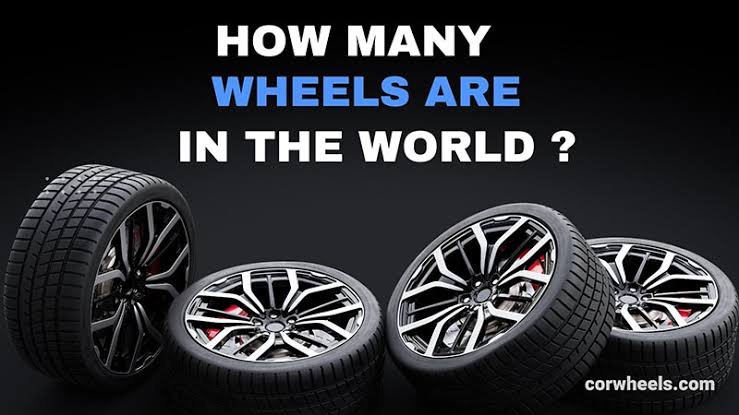
On a quiet morning in suburban America, a logistics manager watches thousands of packages glide along conveyor belts, each roller a spinning wheel in motion. Meanwhile, a toddler in Tokyo gleefully pushes a toy car across the floor, and a farmer in India prepares his tractor for another day of planting. These moments share a common thread: the wheel, humanity’s most underappreciated invention. While we rarely stop to consider it, the question how many wheels are in the world isn’t just a trivia curiosity—it reveals the sheer scale of modern civilization’s dependence on this simple machine.
The exact number is staggering: estimates suggest there are well over 35 billion wheels on Earth when accounting for every vehicle, toy, piece of machinery, and piece of furniture. This count explodes further when we consider gears, pulleys, and casters. The global fleet of cars alone contributes roughly 1.6 billion wheels . Understanding this number means taking a journey through manufacturing trends, market growth, and the hidden corners of our daily lives where wheels quietly power the modern world.
The Billion-Dollar Wheel Economy
To understand the global wheel count, we must first look at the industry that produces them. The automotive wheel market is a financial behemoth, valued at approximately $43 billion in 2024 . This figure represents the massive industrial effort required to keep the world rolling. Market analysts project this value will exceed $58 billion by 2031, driven by a steady compound annual growth rate of 4.6% . This growth signifies not only more vehicles on the road but a shift toward higher-value, technologically advanced wheel designs. Lightweight materials and aesthetic customization are fueling this expansion, as consumers demand more from their wheels than just basic transportation .
This economic activity is concentrated in specific regions. Asia dominates automobile production, accounting for 56% of the world’s output, with China alone responsible for about 32% of global manufacturing . Europe and North America follow, producing 20% and 16% respectively . These production hubs are where billions of new wheels are forged each year. The economic data highlights that the question of how many wheels are in the world is intrinsically linked to industrial output and consumer demand, painting a picture of a sector in constant motion and innovation.
Counting the Wheels on the Road
The most significant contribution to the global wheel count comes from the transport sector. There are over 1.4 billion vehicles on the world’s roads, encompassing everything from passenger cars to commercial trucks . If we assume an average of four wheels per vehicle—though many heavy-duty vehicles have 18 or more—this alone accounts for roughly 5.6 billion wheels . Projections indicate that the number of vehicles in circulation is expected to grow, with an estimated 1.6 billion cars expected by 2025 . This continuous increase directly answers why the number of wheels in the world is perpetually rising.
However, the road fleet is just the tip of the iceberg. We must also include bicycles, which number in the hundreds of millions, and motorcycles. Factoring in the “spare” tires often carried by vehicles further inflates the total. Many estimates suggest the number of wheels purely related to vehicular transport easily surpasses 10 billion when factoring in trailers and commercial fleets. The commercial sector is particularly significant; logistics companies rely on fleets of trucks where each vehicle can contribute up to 18 wheels, accelerating the total count exponentially.
The Hidden Wheels of Industry and Daily Life
Beyond vehicles, the most surprising contributors to the global wheel count are the ones we rarely notice. Consider the casters—those small wheels attached to office chairs, hospital beds, and shopping carts. Estimates suggest there are over 10 billion castors in use worldwide, primarily in the furniture and logistics industries . When we ask how many wheels are in the world, we must include the millions of wheels embedded in conveyor systems, factory rollers, and industrial machinery that keep production lines efficient . These industrial applications are critical but often invisible to the general public.
Our homes are also packed with rotating components. From the wheels on luggage and strollers to the internal gears in clocks and appliances, the count is pervasive. Even the humble skateboard or roller skate adds to the total. This ubiquity explains why the number feels so immense. The wheel has become so integral to daily life that its presence is almost invisible. Understanding this hidden inventory is key to answering the question accurately, highlighting that the wheels we drive on are dramatically outnumbered by those we sit on, push, or rely on for manufacturing.
The Engineering Evolution Behind the Numbers
The type of wheel used also informs the count and value. The industry is seeing a significant shift toward forged aluminum wheels . In 2025, the global forged aluminum wheel market was valued at $6.8 billion and is expected to grow at a rate of 6.6% annually, reaching $10.6 billion by 2032 . Forged wheels are lighter and stronger than traditional steel or cast aluminum, providing better fuel efficiency and vehicle handling. This engineering trend is crucial because it means the “wheels” in the world are not static; they are constantly being upgraded and replaced.
Manufacturers like Alcoa Wheels and Otto Fuchs KG are leading this charge, with Alcoa having pioneered the forged aluminum truck wheel in 1948 . These high-value wheels often grace the vehicles of discerning drivers and commercial fleets. As the global fleet modernizes and consumers demand better performance, the average value of each wheel increases. This evolution indicates that while the count of wheels is rising, the sophistication and cost per wheel are also climbing, representing a significant technological investment in our mobile future.
Key Takeaways
- Staggering Scale: The total number of wheels worldwide easily exceeds 35 billion when accounting for vehicles, casters, machinery, and toys.
- Automotive Dominance: The global vehicle fleet contributes roughly 5 to 6 billion wheels, with continued growth projected in the coming years.
- Hidden Inventory: More than 10 billion wheels exist in the form of casters for furniture and equipment, highlighting how often wheels go unnoticed.
- Market Growth: The automotive wheel industry is a multi-billion dollar sector projected to grow significantly, driven by demand for lightweight forged materials.
- Regional Production: Asia accounts for over half of global automotive production, serving as the primary source for new wheels entering the market.
- Premium Shift: The trend toward forged aluminum indicates a move toward quality and sustainability, changing the economic landscape of wheels.
Frequently Asked Questions
How many wheels are on a standard passenger car?
Most standard passenger cars have four primary wheels. However, when counting the steering wheel and the spare tire, the number increases to six. Including internal mechanical gears and pulleys can push the per-car count to over 20, as seen in some enthusiast calculations .
Are there more wheels or doors in the world?
This is a popular debate. While accurate global counts are difficult, estimates suggest the number of wheels likely outnumbers doors. Considering that vehicles have four wheels and typically four doors, but homes have multiple doors and hidden “wheels” like hinges, the answer depends on the counting methodology, with some calculations showing wheels ahead .
How does the number of vehicles impact the global wheel count?
The number of vehicles is the primary driver of the wheel count. With over 1.4 billion vehicles on the road, each contributing four or more wheels, the transportation sector accounts for the majority of visible wheels globally . Growth in vehicle sales directly increases this number.
What is the market value of the global automotive wheel industry?
The market was valued at approximately $43 billion in 2024 and is projected to reach nearly $59 billion by 2031 . This reflects strong demand and a trend toward high-performance, lightweight materials like forged aluminum.
How many cars are expected to be on the road by 2030?
Projections indicate the global car fleet will continue to grow significantly. While exact figures vary, analysts forecast steady expansion, with some expecting over 1.6 billion vehicles in circulation by 2025, suggesting the number will be even higher by 2030 .
What is the fastest-growing segment in the wheel industry?
The forged aluminum wheel market is one of the fastest-growing segments, driven by demand from luxury, performance, and electric vehicle manufacturers . Its growth rate of 6.6% outpaces the overall wheel market.
Where are most automotive wheels manufactured?
Asia is the largest producer, accounting for 56% of global automobile production. China is the single largest country producer, responsible for about 32% of the world’s vehicles, and by extension, a massive share of its wheels .
The Future of the Global Wheel Count
Looking ahead, the number of wheels in the world is set to rise dramatically. The electric vehicle revolution is a key driver. While EVs often have the same number of wheels as internal combustion vehicles, they require specialized wheels designed to handle heavier batteries and optimize aerodynamics. This has led to a surge in demand for lightweight, forged wheels . Furthermore, the expansion of urban mobility solutions, like e-scooters and bike-sharing programs, adds millions of micro-wheels to the total.
However, there is a push toward sustainability that may slow the raw material count. As manufacturers focus on durability and longevity, the replacement cycle for wheels might lengthen. Yet, the overall trend is undeniable: the global population is growing, urbanization is spreading, and mobility is becoming more accessible. Each new household buys furniture with casters, each new child receives a toy with wheels, and each new road welcomes vehicles. Therefore, answering how many wheels are in the world is not a static figure but a dynamic number that grows with our civilization, symbolizing the endless movement of humanity.
Conclusion
To ask how many wheels are in the world is to glimpse the sheer scale of human ingenuity and industry. While a definitive number is impossible to pin down due to the sheer volume and variety of rotating objects, we know it is in the tens of billions and growing. From the $43 billion automotive market to the 10 billion casters in our offices, wheels are the unsung heroes of modern life . They drive our economy, move our goods, and simplify our daily routines. As technology advances and the global population surges, this number will only climb higher, reminding us that progress is literally a spinning cycle.
Explore the fascinating world of engineering and manufacturing that keeps our planet moving. Subscribe to our newsletter for more deep dives into the data behind everyday life.
You Mey Olso Read
The Quiet Strength of Loralee Czuchna: Life Beyond the Spotlight with Don Knotts
