

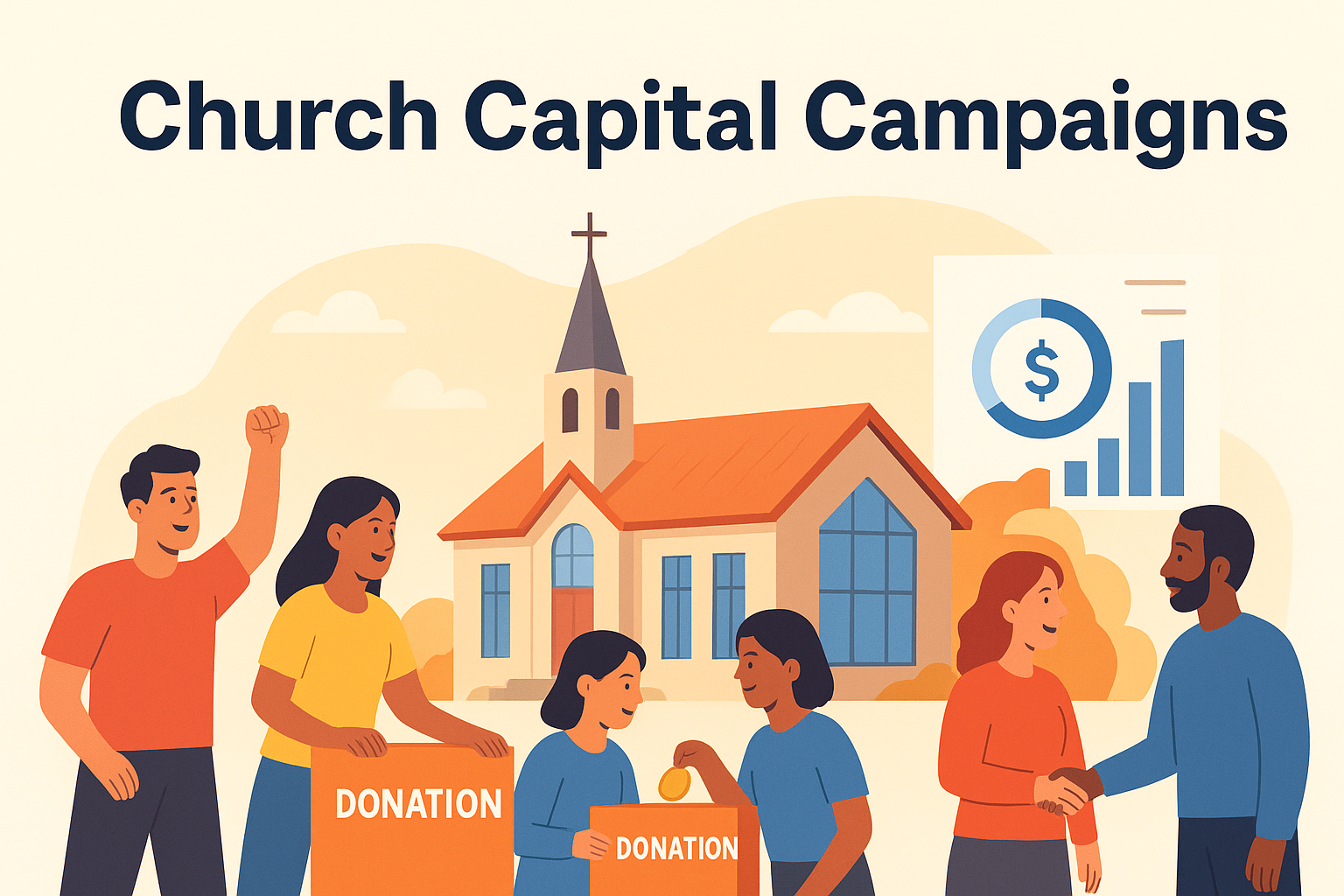
Right now, tens of thousands of U.S. churches are launching or planning church capital campaigns. Some aim to renovate aging buildings. Some need disaster repairs. Many are expanding community programs to meet record social need. But the biggest shift is this: giving has become personal, visual, and emotional. People no longer give to bricks. They give to impact, legacy, and movement.
Something emotional is happening in churches across America. It’s no longer just about stained glass, Sunday sermons, or community dinners. It’s about survival, renewal, and a collective leap of faith. Congregations that once passed offering plates quietly are now launching multi-million-dollar missions with cinematic storytelling, live dashboards, and text-to-give pledges lighting up phones in real time. The most stunning part? The churches winning today aren’t always the biggest. They’re the most honest, human, and bold.
The Urgent Moment Driving Church Capital Campaigns in 2025
Across the United States, 65% of church buildings were built before 1980. Many now require electrical upgrades, accessibility redesigns, roof overhauls, and structural repairs. At the same time, attendance patterns are evolving. Congregations demand hybrid worship, childcare spaces, modern community halls, youth centers, and broadcast-capable sanctuaries. These aren’t luxury requests. They’re survival infrastructure.
Add the economic pressure of inflation, rising utility costs, and higher insurance rates, and the need becomes urgent. This urgency is what has pushed church capital campaigns into a national headline topic. According to giving trend data, faith-based fundraising saw a 27% rise in structured capital campaigns from 2023 to 2025. Churches are no longer avoiding big asks. They are making purposeful ones.
But urgency alone doesn’t raise millions. Emotion does. The churches hitting goal early are not leading with spreadsheets. They are leading with testimony, storytelling, visual proof, and community outcomes. The narrative has changed from “we need a building” to “our community needs a home.”
Why Traditional Fundraising No Longer Works Alone
For generations, church fundraising followed a predictable script: Sunday announcements, pledge cards, offering envelopes, and benevolence dinners. While these elements still play a role, they can’t carry major financial goals alone anymore. Today’s donor mindset values connection, transparency, and participation. They want to see impact before the final result exists.
Modern church capital campaigns now blend digital giving tools, live progress tracking, milestone celebrations, and story-first communication. Donors expect updates, video messages, visual renderings, and honest conversations. The old one-directional “ask” has evolved into a two-way relationship built on stewardship and shared ownership.
The most successful campaigns are also tapping into micro-commitment psychology. Instead of waiting for large pledges, churches are creating layered entry points: weekly giving, small recurring pledges, family-sized commitments, youth fundraising, and community-wide challenges. No one is excluded. Everyone has a role.
The Rise of the Story-Driven Campaign Model
People don’t give to projects. They give to stories. The churches breaking records with church capital campaigns are treating messaging like documentary storytelling, not administrative announcements. Their campaigns include testimonies, historical reflections, impact reels, member spotlights, baptism stories, community outreach proof, and generational legacy messaging.
Story-driven campaigns lean on shared identity. They remind long-time members why they stayed. They show new members why they belong. They tell communities why they matter. When the narrative shifts from “fund a building” to “fund the future of families, recovery, shelter, youth, outreach, and spiritual home,” giving behavior changes dramatically.
It is also clear that campaigns succeed faster when they center transformation over tradition. Donors respond emotionally to missions like mental health support rooms, homeless resource hubs, addiction recovery spaces, feeding centers, disaster relief facilities, and safe childcare expansions. These needs don’t feel optional. They feel urgent and deeply human.
Digital Giving Behaviors Are Rewriting Donation Patterns
Tech adoption within U.S. churches has skyrocketed. In 2025, 73% of faith-based donors now give through mobile, online portals, or text-to-give systems, especially during church capital campaigns. Paper pledge cards still exist, but digital touches are now the engine, not the supplement.
Campaign platforms now include live pledge counters, automated donor thank-you sequences, SMS reminders, short video devotionals tied to giving milestones, and AI-personalized encouragement messages. Churches are also launching social-first outreach strategies where members share campaign stories through Reels, TikTok, Facebook groups, and YouTube testimonies.
This digital momentum brings more transparency. Members can track giving progress in real time. They see dollar velocity, update frequency, and milestone celebrations. This visibility fuels urgency and participation. People give faster when they see others giving too.
Generational Giving Patterns Defining Success
American churches are navigating the biggest generational giving shift in history. Baby Boomers still contribute the largest donations overall. But Millennials and Gen Z are reshaping how churches raise funds. Younger donors prioritize impact clarity, digital convenience, and community participation over formality and ceremony.
During church capital campaigns, younger members respond strongly to recurring micro-giving ($10, $25, $50 weekly), interactive campaign experiences, short behind-the-scenes videos, and mission-based outcomes. They want to know who is helped, not just what is built.
Older generations respond deeply to legacy messaging, heritage storytelling, long-term vision, and stewardship themes. Churches successfully hitting their goals understand both languages. They don’t choose one demographic. They integrate both giving identities into one shared mission.
Mega Campaigns vs Neighborhood Movements
One of the most surprising trends of 2025 is this: smaller churches are outperforming larger ones in fundraising percentage goals. This is not about total dollar volume. It’s about community density. Neighborhood congregations leverage tighter emotional bonds, shared history, and deeper relational networks.
Many small churches with fewer than 300 members are raising $500,000 to $2 million using relational networks, personalized outreach, dinner-table conversations, and grassroots ministry proof. Their church capital campaigns work not because they are loud, but because they are personal.
Meanwhile large churches often have the advantage of digital reach, media budgets, and professional campaign teams. Their campaigns look like coordinated movements built with videography, branding, micro-sites, and multi-platform launch events. Both models succeed when aligned with authenticity, not optics.
The New Campaign Vocabulary: From “Funding” to “Movement”
Communication style is changing. Successful faith-based fundraising no longer uses transactional language like “capital goal” or “building project” as the centerpiece. Instead, it centers on words like mission, legacy, impact, renewal, community, rescue, safety, belonging, future, and hope.
In today’s church capital campaigns, the core message isn’t “help us build.” It’s “help us change lives.” This is why campaigns built around food insecurity, youth mentorship, trauma support, foster family care, drug recovery ministries, and disaster preparedness centers are seeing explosive momentum.
The shift is psychological. People don’t want to fund institutions. They want to fuel transformation. Churches that communicate this clearly remove hesitation and unlock emotional urgency.
LSI Keywords Shaping Faith-Based Fundraising in 2025
Several connected search behaviors reflect how America now thinks about church funding. The most relevant terms include: fundraising, church renovation, stewardship, faith-based fundraising, donor engagement, pledges, nonprofit capital campaign, tithing, and building fund. These terms represent the ecosystem surrounding modern church growth and resource mobilization.
Churches that integrate this language naturally across sermons, print materials, small groups, social media, newsletters, giving pages, and outreach events create recognition, relevance, and long-term support scalability.
redictions for the Future of Church Capital Campaigns
Experts forecast that by 2027, 82% of church fundraising will include hybrid campaign models—mixing digital giving, live events, personal storytelling, and community partnerships. Campaign cycles will become shorter but more frequent. Momentum-driven fundraising will replace long silent pledge seasons.
There will also be a stronger rise in transparency dashboards, project-by-project funding menus, and community sponsorship tiers for renovations, outreach wings, youth centers, and service expansions. Congregations will expect ongoing proof of impact, not just completion photos.
The future winners will be churches that humanize their asks, digitize their systems, diversify their touchpoints, and amplify their mission through sharable stories of transformation.
The One Truth Every Church Must Accept Now
People want to give. They just want to believe first. Not in the bricks. Not in the budget. But in the purpose behind it. The churches redefining generosity are not asking members to fill financial gaps. They’re inviting them into shared legacy.
The heart of church capital campaigns has shifted. It is no longer about raising money. It is about raising momentum, community, ownership, and hope.
Your moment is now
If your church has a vision for growth, renewal, outreach, or restoration, don’t wait for perfect timing. The donors you need are already in your pews, your community, and your digital reach. Speak boldly. Tell the story. Show the need. Make it personal. Make it real. Make it theirs too.
The future of your church is one campaign away.
Start it. Share it. Lead it. Believe it.
