

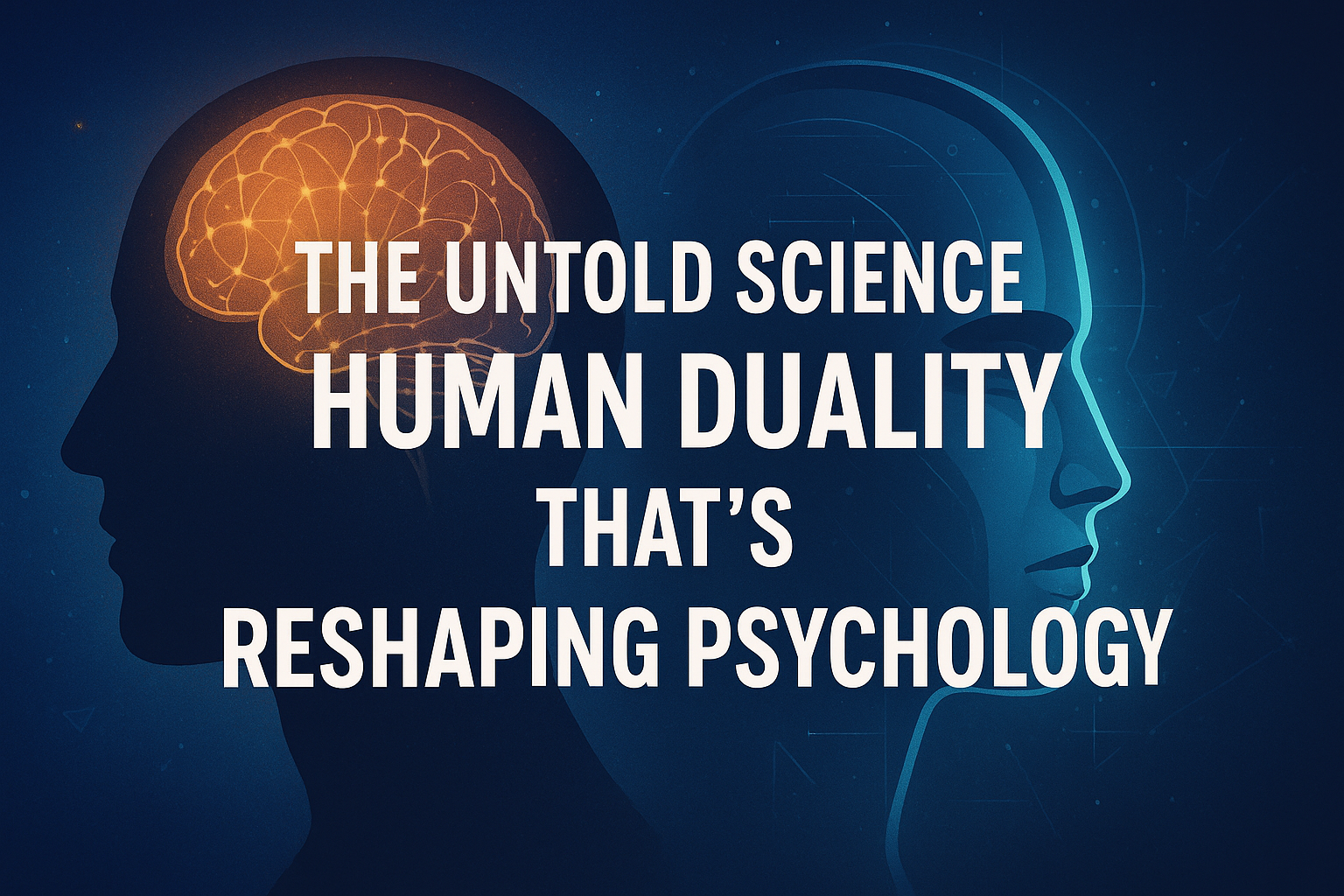
The battle inside your mind is not a flaw. It’s a blueprint. Every decision you’ve ever made—kind or cruel, brave or fearful—belongs to the same internal war billions share but rarely talk about. What if the voice telling you to play safe and the one pushing you to risk it all were both saving your life in different ways? The world calls it overthinking, conflict, or contradiction. Science calls it human duality—a psychological mirror that may explain genius, chaos, empathy, sabotage, love, and self-doubt all at once. This hidden framework is not just personal. It’s shaping modern society, digital behaviour, leadership, creativity, and the future of mental health.
What Human Duality Really Means in Modern Psychology
Human duality refers to the coexistence of two opposing instincts, beliefs, or emotional systems within the same person. It’s the internal push and pull between logic and impulse, intuition and analysis, compassion and self-preservation. Unlike traditional psychology models that try to label personalities into neat categories, human duality embraces contradiction as a core part of identity instead of treating it as dysfunction. Modern neuroscience shows that the brain is not a single unified system but a complex negotiation of competing networks that take turns driving decisions.
Researchers at Stanford recently highlighted that conflicting inner impulses are not a sign of instability but cognitive adaptability. People who demonstrate high levels of human duality often excel in innovation, leadership, emotional intelligence, and creative problem-solving. Their internal friction generates mental flexibility, helping them switch between analytical thinking and emotional intuition depending on circumstance. While society often pushes people to “choose one version” of themselves, science is proving that duality might be the evolutionary advantage humans needed to dominate the cognitive food chain.
The Two Minds You Fight With Every Day (And Why You Need Both)
Inside every person lives a ‘protector self’ and an ‘expansion self.’ The protector avoids risk, values safety, and keeps emotional damage to a minimum. The expansion self seeks change, novelty, passion, growth, and adventure. Human duality exists because survival requires both caution and exploration. If ancestors only played safe, innovation would die. If they only took risks, so would they. Today, the same balance defines modern decision-making, from careers to relationships to emotional choices.
Duality becomes most visible in moments of stress, ambition, love, competition, or uncertainty. One inner voice says “stay, it’s stable,” while the other whispers “leave, you’re meant for more.” Neither is wrong. They represent two psychological engines working simultaneously—one preventing disaster, the other enabling progress. Mental health experts now encourage individuals to stop silencing one voice in favour of the other and instead develop a negotiation between them, an approach that has shown promising results in therapy, leadership training, and resilience coaching.
Why Human Duality Is the Secret Behind Emotional Complexity
Emotions are not linear, and human duality proves it. People can love and detach, crave connection and fear it, want success but avoid responsibility, seek peace yet thrive in chaos. These emotional contradictions are not confusion—they are adaptive mechanisms. Psychologists increasingly argue that emotional complexity is a stronger indicator of psychological maturity than emotional stability. A person who has never felt internal conflict simply hasn’t evolved enough to navigate life’s deeper layers.
Studies published in 2024 show that individuals who acknowledge their conflicting emotions report 37% higher life satisfaction than those who force emotional uniformity. Human duality allows emotional contrast, which improves empathy, intuition, and relationship intelligence. Those who accept their dual nature also recover faster from heartbreak, betrayal, career failure, and identity crises. What once looked like emotional instability is now being redefined as emotional range—the same range displayed by influential athletes, artists, activists, and entrepreneurs shaping global culture.
The Digital Age and the Rise of a Dual Identity Society
Social media has turned human duality into a visible cultural phenomenon. Online, people present confidence while battling insecurity offline. They post motivation while questioning purpose. They chase validation yet reject it. Digital psychology researchers call this the “public versus private self paradox,” the largest social experiment in human duality ever recorded. Platforms amplify contrasts by rewarding curated personas, while true emotional processes unfold privately.
Surprisingly, this dual identity isn’t entirely harmful. Experts suggest it reflects the human need to evolve faster than circumstances allow. The online self often becomes the prototype of who someone wants to become in reality. In this sense, human duality functions like a psychological rehearsal stage for future identity. The danger only begins when the gap between the two selves becomes too wide, preventing authenticity, emotional bonding, and internal peace. Instead of condemning the contrast, modern digital psychology encourages individuals to use it as data for self-awareness and transformation.
How Leaders and Innovators Use Human Duality to Win
Some of history’s most influential figures were powered by internal contrast. Visionary leaders display both empathy and decisiveness. The greatest inventors balance obsession with detachment. The strongest changemakers mix rebellious thinking with strategic patience. Human duality becomes a competitive edge when understood and managed creatively. Rather than neutralizing internal conflict, leaders channel it into cognitive advantage.
Corporate behavioural studies show that executives who embrace their dual instincts make 28% faster decisions and deliver 31% higher innovation outcomes compared to those who force rigid thinking. Many companies now design leadership models around duality frameworks, teaching executives to combine logic with intuition, emotional intelligence with competitive mindset, and long-term vision with short-term execution. The future of leadership is not about choosing between softness or strength—it belongs to those who can switch between both without losing authenticity.
The Neuroscience Behind Your Conflicting Inner Voices
The brain contains multiple decision-making networks that rarely agree at the same time. The default mode network reflects identity, memory, and emotion. The executive network governs reasoning, logic, and risk assessment. The salience network switches attention depending on urgency. When these systems pull in different directions, we experience inner debate, hesitation, spontaneity, or self-contradiction. Human duality is not philosophical—it’s biological.
Brain imaging studies reveal that high performers show stronger connectivity between conflicting neural networks, meaning their brains negotiate rather than silence opposition. This allows faster adaptation, better crisis response, improved emotional calibration, and stronger intuition. Neuroscientists now argue that the goal should not be to “think as one,” but to “think in counterbalance,” the same mental design that allows pilots to calculate risk without freezing, artists to feel deeply without collapsing, and entrepreneurs to fear failure without avoiding action.
Human Duality in Relationships, Love, and Attachment
Contradictions shape every emotional bond. People want love but fear vulnerability, want loyalty yet protect independence, desire intensity but avoid emotional risk. Relationship experts say human duality is not the enemy of connection—it is what makes connection real. Two people do not fall in love because they are consistent. They connect because their contradictions feel understood rather than judged.
Modern attachment psychology highlights that long-lasting relationships succeed when partners give space to each other’s dual nature instead of demanding emotional uniformity. Secure relationships are not built on always agreeing or matching moods, but on respecting internal contrasts without seeing them as rejection or instability. Emotional intimacy grows when two people feel safe showing both courage and fear, ambition and exhaustion, certainty and doubt, passion and silence.
Signs You Have a Strong Dual Nature (Not a Broken One)
People with high levels of human duality often think deeply but act quickly when necessary. They love routine but reinvent themselves when bored. They care intensely yet need solitude. They question everything but trust their instincts. They feel older than their age yet childlike in curiosity. Their emotional range confuses others but empowers them. These traits are often mistaken for inconsistency, when in fact they signal psychological depth.
Psychological assessments now show that traits previously labeled as “conflicted personalities” strongly overlap with creative intelligence, strategic thinking, resilience, emotional wisdom, and visionary leadership. If society stopped pathologizing internal contradiction, millions would recognise that they are not struggling with themselves—they are evolving through themselves.
Future Predictions: Why Human Duality Will Define the Next Decade
Mental health movements, leadership training, digital self-concept research, and neuroscience are rapidly shifting toward duality-based frameworks. By 2030, psychological models are expected to abandon rigid personality typing in favour of dynamic identity systems that allow contradiction, growth, and internal negotiation. Personal development will move from “fixing yourself” to “understanding both selves.”
Workplaces are already redesigning hiring models to identify candidates who demonstrate strategic dual thinking. Schools are testing curriculums that balance analytical intelligence with emotional cognition. Therapy is shifting from symptom control to identity integration. Human duality will shape future industries including mental wellness, artificial intelligence behaviour design, leadership analytics, and digital psychology.
How to Stop Fighting Your Dual Nature and Start Using It
The key is not forcing harmony but creating cooperation between both sides of your mind. Speak to internal conflict like a boardroom discussion, not a battlefield. One voice identifies risk, the other identifies reward. One protects your heart, the other expands it. When both are heard instead of suppressed, decisions become sharper and self-trust increases.
Experts recommend journaling conflicting desires instead of judging them, making decisions that honour both caution and ambition, and treating emotional contradictions as valuable internal data instead of personal failure. Human duality stops feeling heavy once you stop demanding that you choose only one direction.
The Truth No One Told You
You do not have two selves because you are divided.
You have two because you are built to survive, evolve, and transform.
The world needs thinkers who feel deeply, achievers who dream wildly, and humans who are brave enough to contain more than one truth at once. That is human duality, not human defect.
You may also read
Ultimate Beer Holidays 2025 Guide for Real Ale and Travel Lovers
